Showing posts with label black history. Show all posts

Saturday, February 20, 2010

Black History: The Little Rock Nine

 
L to R: (sitting) Thelma Mothershed, Minnijean Brown, Elizabeth Eckford, Gloria Ray, (standing) Jefferson Thomas, Melba Beals, Terrence Roberts, Carlotta Walls, NAACP president Daisy Bates, Ernest Green.

The Little Rock Nine were a group of African-American students who were enrolled in Little Rock Central High School in 1957, who were initially prevented from entering the school by then-Arkansas Governor Orval Faubus until then-President Dwight Eisenhower intervened, allowing the students to attend.

After the U.S. Supreme Court ruled their decision in Brown v. Board of Education on May 17, 1954, declaring establishing segregated schools to be unconstitutional and called for the desegregation of all schools throughout the nation, the National Association for the Advancement of Colored People (NAACP) began to register black students into previously all-white schools in the south. After the Little Rock School Board agreed to comply with the Supreme Court's ruling, they implemented a plan for gradual integration of its schools, which would begin in September 1957. The NAACP registered the nine black students, selected based on excellent academic performance and attendance, to attend Little Rock Central High: Ernest Green, Elizabeth Eckford, Jefferson Thomas, Terrence Roberts, Carlotta Walls LaNier, Minnijean Brown, Gloria Ray Karlmark, Thelma Mothershed and Melba Beals.

On September 4, 1957, Governor Faubus deployed the Arkansas National Guard to support segregationists when they threatened to protest and block the students from entering Central High. Initially, Faubus supported the high court's 1954 landmark decision but he didn't want to risk losing support of the Democratic Party in the upcoming gubernatorial primary for supporting the integration. At the time, southern conservative Democrats dominated southern politics and were mostly segregationists. The stand-off caught national headlines and President Eisenhower intervened, warning Faubus not to interfere with the court's ruling. On September 24th, Eisenhower ordered the 101st Airborne Division of the U.S. Army to Little Rock and federalize the 10,000 member Arkansas National Guard, taking control from Faubus' hands. Once the Army took their positions, the Little Rock Nine successfully entered school on September 25, 1957.

The students were still subjected to physical and verbal abuse. Although one student, Minnijean Brown, was suspended and expelled then transferred to a school in New York City, the remaining 8 still attended Central High. At the end of the school year, Ernest Green became the first African American to graduate from Little Rock Central High.

Tuesday, February 16, 2010

Black History: Ali - The World's Greatest

 
"Champions aren't made in gyms. Champions are made from something they have deep inside them...
A desire. A dream. A vision.
They have last-minute stamina. They have to be a little faster. They have to have the skill and the will. But the will must be stronger than the skill."

R. Kelly.::The World's Greatest::.

Saturday, February 13, 2010

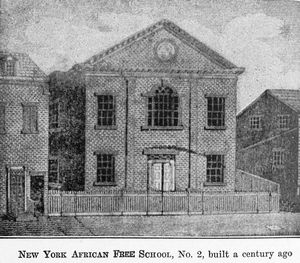
Black History: African Free School

 
The African Free School was an institution founded by the New York Manumission Society, an organization that advocated the full abolition of African slavery, in November 1787 in New York City.
The organization's members were all wealthy and influential white men, founded by statesman and abolitionist John Jay and included Alexander Hamilton among its members.
The original institution, the first free school founded to provide education to the children of slaves and freemen, was a one bedroom schoolhouse that held about 40 students. By the end of its term as a private school, there were a total of seven schools and had educated thousands of girls and boys.
The school was founded just nine years after the society helped a state law passed in 1785 that prohibited the sale of slaves imported into the state. The law also eased on the manumission of Africans already committed to slavery. In 1835, African Free School was integrated into the public school system.

Sunday, February 7, 2010

Black History: Mary McLeod Bethune

 
An African-American educator and civil rights lead best known for starting a school for black students in Daytona Beach, Fl. that eventually became Bethune-Cookman University, and was also appointed as an advisor to President Franklin D. Roosevelt.

Monday, February 1, 2010

Black History: The Greensboro Sit-ins

Today marks the first day of Black History Month. It's a time where we look back and honor the many historical African-American events, inventors, leaders, activists, educators and entertainers. What better way to kick things off than to honor the four young college students that sparked a national civil rights movement fifty years ago today?
 
On Feb. 1, 1960, the Greensboro Four, as they would later be called, felt isolated and alone as they sat at that whites-only lunch counter at the Woolworth Store on South Elm Street.
They were seeking more than what they ordered — sodas, coffee, doughnuts. They were attacking the social order of the time. The unwritten rules of society required black people to stay out of white-owned restaurants, to use only designated drinking fountains and restrooms, to sit in the rear of Greensboro city buses, in a separate balcony at the Center Theatre and in segregated bleachers during sports events at War Memorial Stadium.
The four black youths — Franklin McCain, Joseph McNeil, Ezell Blair Jr. and David Richmond, all still teenagers and all freshmen on academic scholarships at N.C. A&T State University — had entered the unknown. McCain, who grew up in Washington and spent one year attending Greensboro's Dudley High School, says he expected to be arrested, beaten to a pulp or worse.
All four would emerge unscathed and eventually be recognized as heroes of the civil rights movement.
They were persistent. In the days after Feb. 1, they would be joined by other students at the Woolworth counter and at the Kress 5 & 10 lunch counter a half-block away. Their protests inspired black people to do the same at Formica-topped dime-store counters in other cities. The movement they started led to the integration of the Woolworth and the Kress chains, landmarks on every main street in the South.
In the months that followed, more sit-ins began to spread throughout the South at many segregated stores, most of them peaceful and ending with positive results. The Greensboro Woolworth store desegregated its lunch counter on July 26, 1960, serving blacks and whites alike. 

Monday, January 18, 2010

Celebrate the Dream...

We came a mighty long way...


...but we still have a long way to go.